
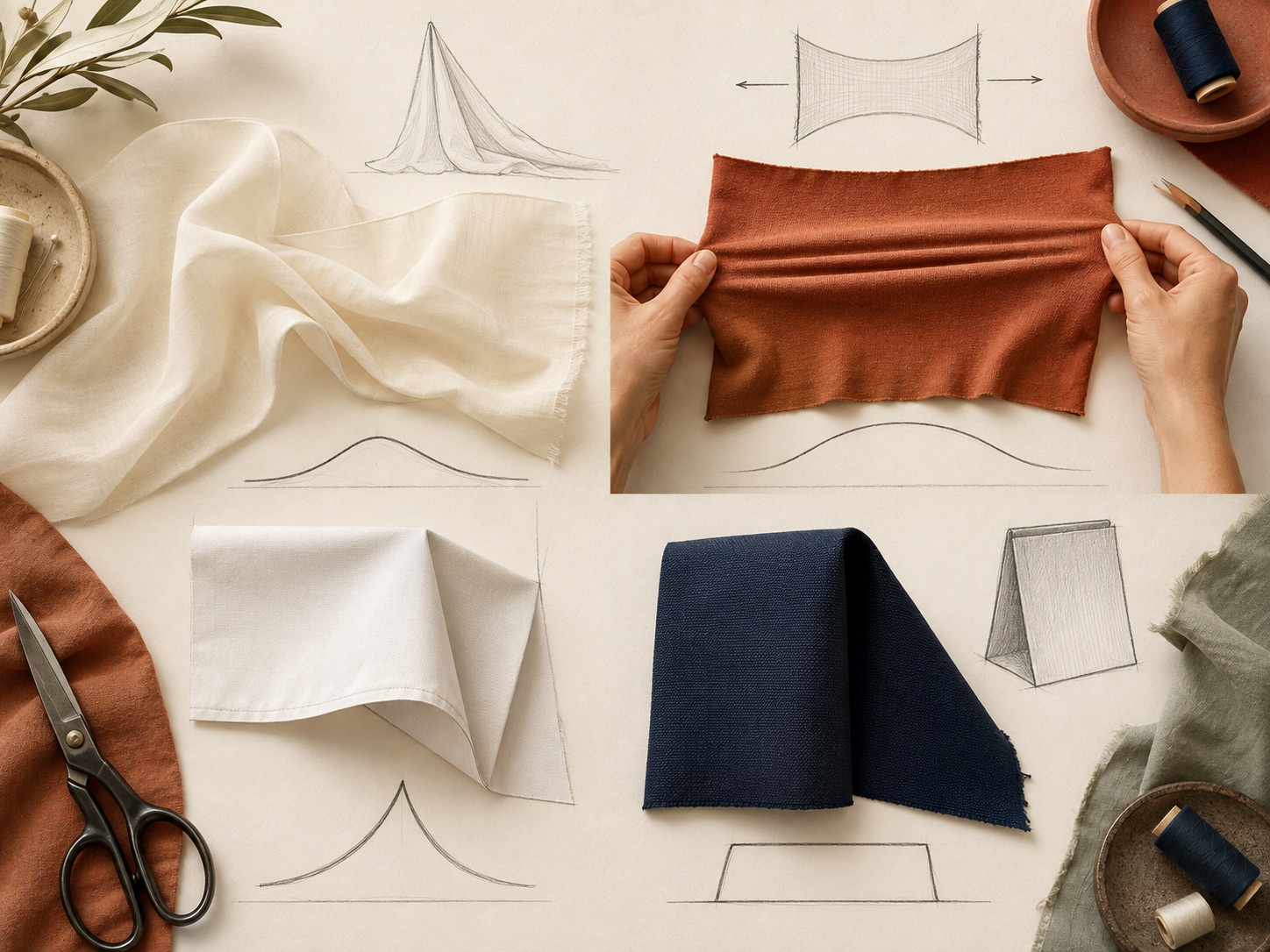
Start with the pattern's fabric requirement
Find the recommended fabric type and, for knits, the required stretch direction and percentage. A woven blouse and a jersey top may look similar in a photograph but need different fabrics to fit. Fibre names such as cotton or polyester do not tell you whether a cloth is woven, knitted, stiff or fluid.
Write down the fabric width, too. A quantity calculated for 160 cm-wide cloth does not transfer to a 140 cm width. Use the layout for your size, including any lining, contrast pieces and matching of checks or stripes.
Measure stretch and check recovery
Mark two points 10 cm apart away from the cut edge. Stretch that section in the direction the pattern specifies, without forcing or distorting it. Measure the distance between the marks again.
Stretch percentage = (stretched length − original length) ÷ original length × 100. If 10 cm becomes 13 cm, the stretch is 30%. That is a calculation example, not a pass mark for every knit pattern. Test both directions when the pattern requires stretch both across and along the fabric. Megan Nielsen's stretch guide shows the measurement method.
Let go and measure again after the fabric relaxes. If it stays longer, it has not fully recovered. A neckband made from it may loosen in wear. Curling at a jersey's cut edge is a separate behaviour; curling alone does not tell you how well the fabric recovers.
Look at what the fabric does when it hangs
Drape a generous piece over your hand, then hold it from one edge. Does it fall into small folds or stand away in broad shapes? A gathered skirt made from crisp poplin will hold more volume than one made from a fluid cloth. Neither result is automatically wrong, but it should be the result you want.
Lay a single layer over a contrasting colour in daylight and check how much shows through. Then place it over the lining you plan to use and check again. Keep the cloth relaxed during this opacity test. Decide whether to add lining before estimating how much fabric to buy.
Test the thickness where seams meet
Fold a scrap into the number of layers the project will contain: pocket corners, cuffs and waistbands can be much thicker than the main garment. Sew through that stack with a suitable needle and stitch. Check the underside for skipped stitches and the surface for puckering.
Then move the sample to an ironing board. Test the care-appropriate temperature and a press cloth in an inconspicuous area. Let it cool before checking for shine or flattened texture. Check whether the seam stays flat and whether any crease the design needs holds after cooling.
Keep one useful sample
Label a swatch with fabric type, width, washing method, stretch result, needle type and size, stitch type and stitch settings. Wash or otherwise prepare the fabric as its care instructions allow before cutting. A swatch with a sewn seam tells you more about suitability than a fibre label on its own.
Frequently asked questions
Can I use sweatshirt fabric for any knit pattern?
No. Sweatshirt knit, jersey and rib can differ greatly in stretch and recovery. Match the pattern's requirement and test the band fabric separately from the body fabric.
What if I cannot find the required stretch percentage?
Check the pattern instructions or ask before cutting a close-fitting knit. Do not choose a percentage from an unrelated garment and assume it applies.